

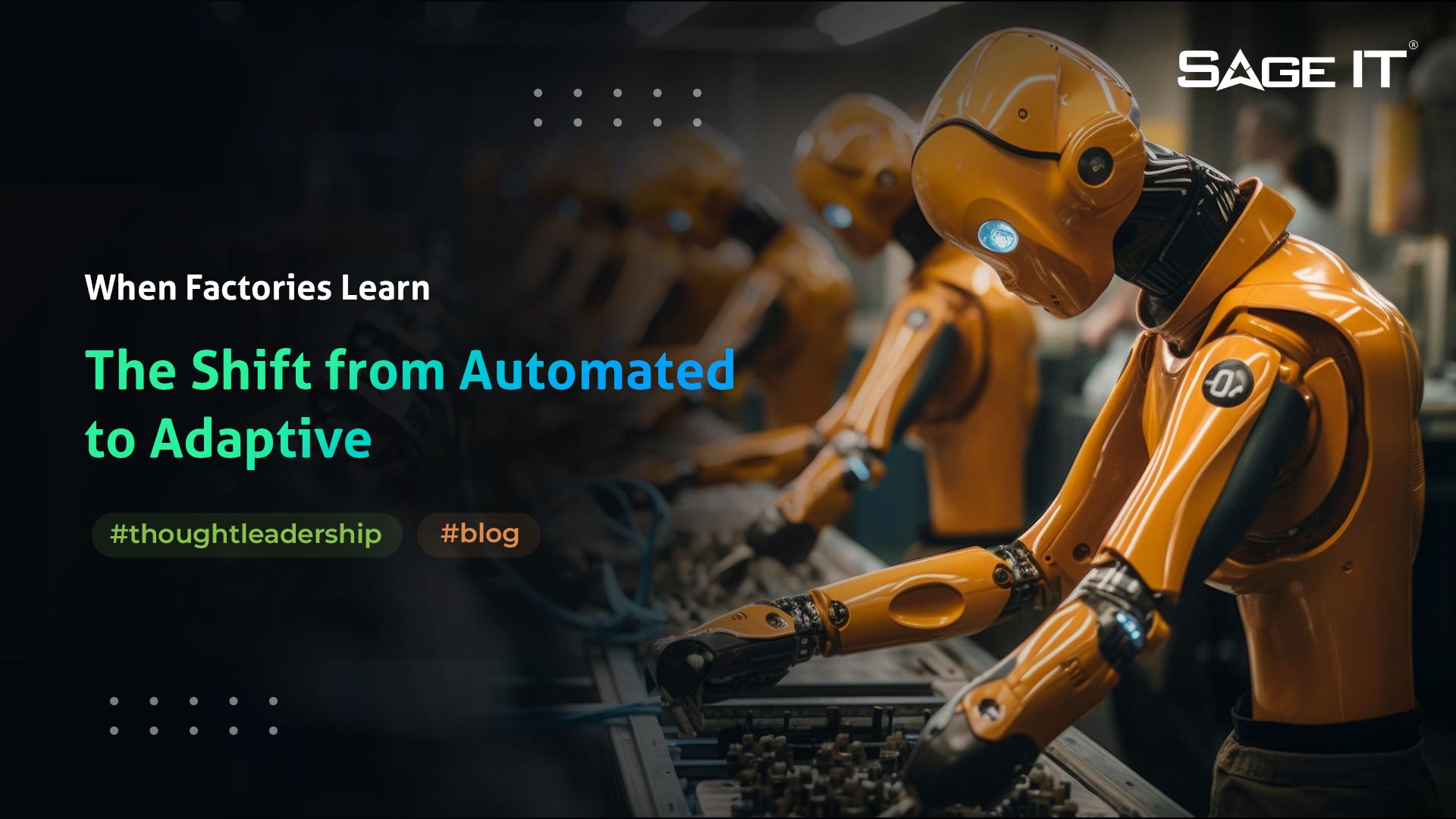
Margin pressure isn’t a cycle anymore. It’s the new baseline.
Labor is tighter. Demand is jumpier. Supply networks fracture without warning. Energy costs swing. Quality expectations rise while customers ask for more variants, delivered faster.
In that environment, the next advantage isn’t “more automation.” It’s adaptive operations: a factory floor that can sense, reason, and respond—fast enough to protect throughput, quality, and cost when reality deviates from plan.
That’s what I mean by a self-aware factory floor. Not a shiny robot. Not another dashboard. A capability: the plant’s ability to run a closed feedback loop where humans and machines operate as one performance system—an idea that aligns with the broader “human + machine” shift in how work gets redesigned.
Don’t buy a dashboard. Build a loop.
A self-aware floor is an operational feedback loop:
Sense → Interpret → Decide → Act → Learn
Traditional automation hard-codes a process. Self-aware operations adapt the process. That difference is where margin lives.
Where margin shows up first
When manufacturers actually run this loop, the gains usually concentrate in four buckets:
- 1
Uptime and throughput: fewer unplanned stops, higher utilization
- 2
Quality and yield: less scrap/rework, fewer customer returns
- 3
Labor productivity: decoupling revenue growth from headcount growth
- 4
Energy optimization: moving energy from a fixed overhead cost to a variable cost managed in real-time
The insight here isn’t “AI saves money.” It’s AI changes the control system of the plant—from reactive to anticipatory.
Why 2025–2026 feels like a tipping point
Three threads are converging into something operational leaders can actually scale:
1) Digital twins are moving from concept to “scale enabler.”
The hard part was never building one twin in one plant. The hard part was making twins portable across equipment vendors, sites, and suppliers.
Scalability in technologies like digital twins is crucial to ensure interoperability across the entire factory network. Standards and reference architectures matter here—not because standards create value, but because they reduce integration friction and make scale repeatable.
2) Industrial copilots are becoming the user interface to the floor.
Operators don’t want a dashboard. They want answers:
Copilots turn scattered plant knowledge—manuals, work orders, tribal expertise—into guidance at the moment of need. That’s how you convert “expert scarcity” from a crisis into a constraint you can manage.
3) Agentic workflows are emerging as the closed-loop layer.
Copilots assist. Agents plan and trigger work within boundaries: monitor signals, open work orders, regenerate schedules, recommend parameter changes, escalate exceptions. Done right, agents don’t replace engineers—they remove latency from execution.
The Executive Trap: Treating This Like a Technology Install
Most failures aren’t algorithm failures. They’re operating model failures:
This is why “self-aware” isn’t a software project. It’s a work redesign project. Value isn’t created by the install; it’s created by the adoption.
A Pragmatic CXO Playbook: From Pilot to Plant Network
Step 1: Pick a narrow, expensive failure mode.
Start where economics are undeniable:
- Chronic unplanned downtime on a constraint asset
- A defect mode driving major scrap/rework
- Schedule instability causing late shipments
- Energy peaks with measurable cost impact
Step 2: Build the minimum viable closed loop.
Not “twin everything.” Build what decisions require:
- The smallest asset/process model that supports action
- The minimum sensor set that detects drift early
- A cost model that prioritizes interventions
Step 3: Design for ‘Human-on-the-Loop’, not just ‘in-the-loop’.
Early wins come from assistive autonomy:
- AI recommends
- Humans confirm and execute
- Outcomes feed learning
This builds trust and creates the best training data you’ll ever get: a trace of decisions, context, and results.
Step 4: Integrate into the systems that run work.
If insights don’t hit execution systems, they don’t exist. Connect into:
- CMMS/EAM (maintenance)
- MES (execution)
- QMS (quality)
- APS (planning/scheduling)
- ERP (inventory/procurement)
Step 5: Scale by similarity—then connect end-to-end.
Scale across similar assets/lines first. Then extend the loop across:
- Upstream supply variability
- Downstream demand changes
- Logistics constraints
The KPIs That Keep Everyone Honest
Instrument outcomes like an operating capability, not an innovation program:
These metrics create a common language from plant leadership to the C-suite—and prevent “pilot theater.”
The Closing Truth
In the last decade, advantage came from connectivity and automation. In the next decade, advantage comes from adaptive execution—factories that learn faster than disruptions accumulate.
Digital twins, industrial copilots, and agentic AI for enterprise workflows are converging to automate decision-making and execution across operations.
The smartest models won’t win. The fastest feedback loops will.
That’s why the self-aware floor is becoming the new battleground for margin.