

The most important impact of AI is not technological. It is human.
As generative AI evolves into agentic systems, meaning AI that can plan, reason, and take action across tools and workflows, competitive advantage will be determined less by which models organizations deploy and more by how their people work with machines.
The transition from Generative AI to Agentic AI is not a software upgrade. It is a delegation crisis.
The first wave rewarded prompting. This wave will reward supervision. The bottleneck is no longer how much information we can generate. It is how much decision-making and execution we can safely delegate, transparently and repeatably, without losing accountability.
This is the core insight behind HUMAN + MACHINE: value is created not by automation alone, but by fusion skills, learnable capabilities that enable humans and AI to collaborate productively, responsibly, and at scale. These skills are quickly becoming the dividing line between organizations that harness agentic AI as a force multiplier and those that experience it as chaos, risk, or disappointment.
Why the agentic workplace changes the skills equation
Earlier waves of enterprise software automated tasks. Employees adapted by learning tools and processes. Agentic AI changes the operating model. Systems can interpret intent, break goals into steps, access enterprise tools, execute actions, and learn from outcomes.
Humans are no longer just users of technology. They become accountable owners of machine-driven execution, collaborators who shape intent, supervisors who validate actions, and stewards who govern risk.
A simple clarity check helps:
What breaks in agentic environments
Agentic AI introduces predictable failure modes, not because systems are malicious, but because delegation can outpace supervision.
The most common breakdowns include:
These are not theoretical. They are the operational reality of autonomy at scale.
Done well, agentic AI compounds human judgment. Done poorly, it compounds risk.
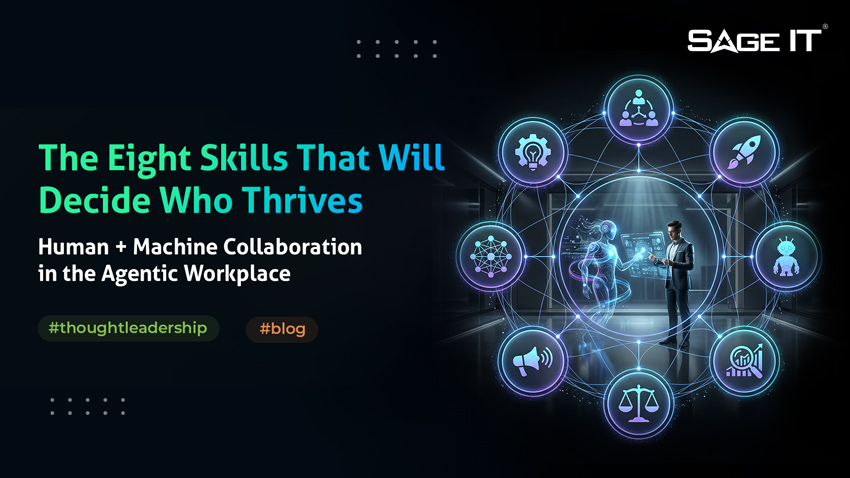
The eight fusion skills for the agentic workplace
These eight skills are practical and learnable. More importantly, they are observable in day-to-day work. Each one can be reinforced through a repeatable practice and measured through an artifact leaders can review.
1) Intelligent interrogation
In agentic work, you are not just checking whether an answer is right. You are checking whether a plan is safe. Agentic systems are persuasive by design, which is why interrogation is the antidote to blind trust.
Build the habit: use the “3-Question Rule.” What assumptions are being made? What would change the recommendation? What is the safest next action?
Make it measurable: require a short decision brief that lists assumptions, risks, a verification step, and human sign-off.
2) Judgment integration
Agentic AI optimizes patterns. Humans own context, ethics, and accountability. This matters most in regulated, safety-critical, and customer-facing environments where responsibility cannot be delegated.
Build the habit: separate decisions into two lanes. Reversible actions can run with logging and sampling audits. Irreversible or high-risk actions require explicit human approval.
Make it measurable: maintain a decision RACI with sign-off points and escalation triggers.
3) Reciprocal apprenticing
Humans learn faster by observing AI-generated analyses and drafts. Agents improve when humans correct, override, and teach. Advantage compounds when feedback becomes systematic rather than informal.
Build the habit: treat feedback as operational data. Tag failures across policy, context, reasoning, and tool use, then capture the corrected output and the reason.
Make it measurable: maintain a structured feedback log tied to evaluation and updates.
4) Bot-based empowerment
Delegation is a productivity multiplier, but only when it is designed rather than improvised. Empowerment is not abdication. The human remains accountable for outcomes.
Build the habit: delegate, verify, and approve. Delegate bounded tasks, verify against a checklist, and approve only when conditions are met.
Make it measurable: use a runbook defining scope, escalation rules, and approval checkpoints.
5) Holistic melding
Holistic melding is not adding AI to steps. It is redesigning workflows so human and machine contributions are inseparable. This is the “missing middle,” where work is no longer split into human tasks and machine tasks, but redesigned as one system.
Build the habit: design human-in-the-loop intentionally. Define decision gates, escalation thresholds, and audit requirements.
Make it measurable: maintain a workflow map showing agent actions, human gates, and logging points.
6) Rehumanizing time
AI saves time. The strategic question is what leaders do with it. Without intention, efficiency disappears into busyness. With intention, it becomes better work, not just faster work.
Build the habit: treat time savings as a dividend and decide where it gets reinvested each quarter.
Make it measurable: maintain a time dividend plan tied to outcomes in customer experience, quality, or innovation.
7) Responsible normalizing
In many organizations, AI is either hidden as shadow usage or treated as an exception reserved for experts. Responsible normalizing makes AI use safe, routine, and visible, reducing fear, misuse, and fragmentation.
Build the habit: adopt “visible by default.” Disclose agent use, log actions, and follow shared standards and boundaries.
Make it measurable: publish a simple AI use policy with allowed, restricted, and prohibited categories, plus audit expectations.
8) Relentless reimagining
Relentless reimagining is the habit of redesigning work as capabilities change. If AI can do this, why are we still working this way? In fast-moving environments, static processes decay quickly.
Build the habit: run a monthly workflow reset. Pick one workflow, remove one handoff, and automate one verification step.
Make it measurable: maintain a redesign backlog with owners and outcome metrics.
Why fusion skills are now a leadership priority
In the agentic workplace, fusion skills are not “soft skills.” They are operational capabilities.
Organizations that fail to build them typically see overreliance on AI, underutilization of AI, inconsistent quality, rising risk, and cultural resistance. Those that succeed see faster decision cycles, stronger judgment, higher trust, and sustained performance gains.
The difference is not model capability. It is human capability.
Turning fusion skills into an operating model and a talent system
Fusion skills do not emerge from one-off training. They must be embedded into how the organization runs.
Start with five operating mechanisms:
- 1
An agent registry that inventories agents, purpose, owners, permissions, tools, environments, and logging status.
- 2
Decision RACI that defines where humans must sign off, what triggers escalation, and which actions are reversible versus irreversible.
- 3
An evaluation loop that measures decision quality, cycle time, consistency, risk reduction, and outcomes, then updates prompts, constraints, tools, and policies accordingly.
- 4
Incident response with an escalation path, pause and rollback capability, forensic logs, and post-incident learning.
- 5
A global kill switch or circuit breaker, because executives need a clear control to stop cascading behavior.
Then embed fusion skills into the talent system:
What I would do in the next 30 days
What this means for leaders
As AI becomes more agentic, advantage shifts from model selection to execution quality. The organizations that win will be the ones that define accountability clearly, supervise autonomous actions consistently, and embed human judgment into the loop.
Fusion skills are the new literacy of the AI age. They are teachable, observable, and decisive in outcomes. Companies that build them will translate agentic AI into sustained performance gains. Companies that do not will face growing operational risk and diminishing trust, even as their systems grow more capable.
In this next phase, technology will accelerate. Human capability will determine results.
Acknowledgment
This perspective builds on the foundational ideas introduced in Human + Machine: Reimagining Work in the Age of AI by Paul R. Daugherty and H. James Wilson, extending them into today’s agentic AI environment and enterprise operating realities.