

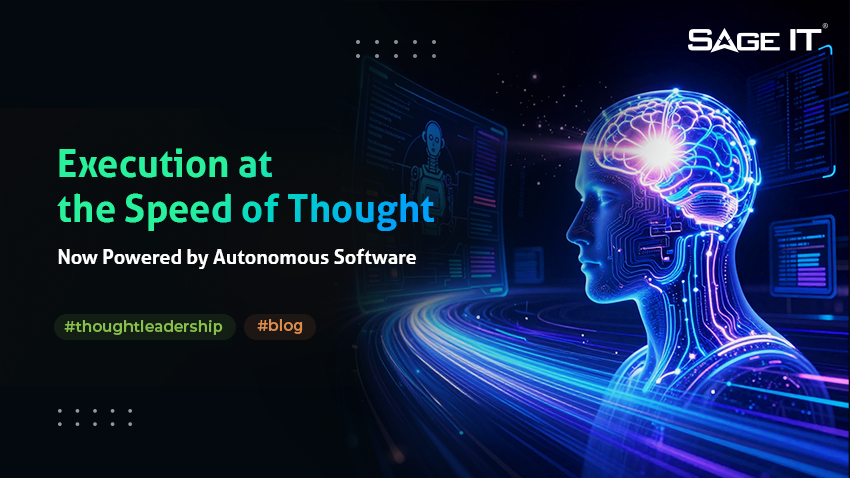
In 1999, Bill Gates wrote Business @ the Speed of Thought. His central insight was simple but profound: a company’s success depends on how fast it can sense, interpret, and act on information.
Speed alone was never the point. What mattered was how well an organization could think and respond.
Gates introduced the idea of a “digital nervous system.” In the human body, nerves carry signals instantly. In a company, digital systems should move information just as quickly. Routine decisions become automatic. Leaders spend less time searching for data and more time applying judgment.
That vision was about information flow.
Today, we are entering the next phase: execution at the speed of thought.
The Collapse of Decision Latency
For decades, organizations operated in three distinct speeds:
Strategy was formed in leadership meetings. Plans were documented. Teams interpreted them. Roadmaps were built. Code was written. Months passed.
There was always latency between intent and action.
Today, that latency is collapsing.
We are moving toward a model where:
Intent → Software → Action
can occur in a single cognitive loop.
This is not about faster typing or shorter meetings. It is about software systems that can interpret direction and convert it into operational change immediately, within defined guardrails.
This is the inflection point.
From Insight to Execution
Business @ the Speed of Thought focused on getting the right information to the right people faster.
Now, software is evolving beyond presenting insights. It is becoming an active participant in execution.
Autonomous systems do more than surface dashboards. They:
Leaders state direction. Systems translate that direction into running processes.
Plans no longer sit in slide decks. They become live logic inside enterprise platforms.
Software shifts from a passive tool to an active contributor.
When done correctly, the business doesn’t just move faster. It becomes structurally capable of acting at the speed its leaders think.
The Rise of the Intention Economy
For years, competitive advantage came from better planning and better resourcing. Execution cycles were measured in quarters.
That model no longer matches market reality.
We are entering what can be described as the Intention Economy, where advantage is defined by how quickly an idea becomes operational reality.
In this environment:
The winners will not be the organizations with the most detailed strategies.
They will be the ones that translate intent into working systems first.
The race is no longer about who writes better plans.
It is about who converts direction into running software faster than competitors.
From Copilot to Autonomous Crews
AI in software development began as assistance, code suggestions, syntax completion, productivity gains.
That was the copilot phase.
We are now seeing a shift toward autonomous execution:
More importantly, these agents can operate in coordinated groups, specialized digital crews working across repositories, frameworks, and environments.
This changes the equation.
The constraint in software development is no longer purely human bandwidth. It becomes orchestration, governance, and clarity of intent.
Execution capacity expands dramatically, if structured correctly.
The Architecture of Controlled Autonomy
To make this work at enterprise scale, a clear stack is emerging:
- 1
Reasoning engines that plan and refine tasks
- 2
Secure tool layers that connect to repositories and enterprise systems
- 3
Orchestration layers that coordinate agents safely
The orchestration layer matters most. It determines whether autonomy expands capability, or introduces chaos.
Without governance, autonomy is a risk.
With governance, autonomy becomes competitive leverage.
The goal is not uncontrolled automation. It is structured, accountable execution aligned to leadership intent.
Demonstrated Enterprise Value
The early excitement around AI coding has matured into measurable outcomes.
Across industries, autonomous systems are already delivering returns in areas that traditionally consume enormous engineering capacity:
These tasks rarely generate new revenue. But they absorb senior engineering talent.
When autonomous systems handle them, experienced engineers shift upward, focusing on architecture, risk, and innovation.
This is not just productivity improvement.
It is a reallocation of cognitive capital.
The Talent Shift
As autonomy increases, engineering roles evolve.
High-value engineers now:
Skill shifts from syntax mastery to systems thinking.
This is not deskilling. It is elevation.
The best engineers operate at a higher level of abstraction, guiding execution rather than performing every step manually.
Organizations that recognize this shift early will build stronger human–AI collaboration models.
Designing the Shift Intentionally
“Speed of thought” no longer means faster dashboards. It means shrinking the gap between the strategic idea and the working product.
Competitive strength now rests on learning speed.
The fastest organizations:
Autonomous software amplifies human judgment. It does not replace it.
The tools are maturing. Financial returns are visible. Governance models are stabilizing.
The real question for leadership is simple:
Will you design this transition deliberately, or react after competitors have already collapsed their decision latency?
Because in the Intention Economy, advantage belongs to those who move from thought to execution first.