
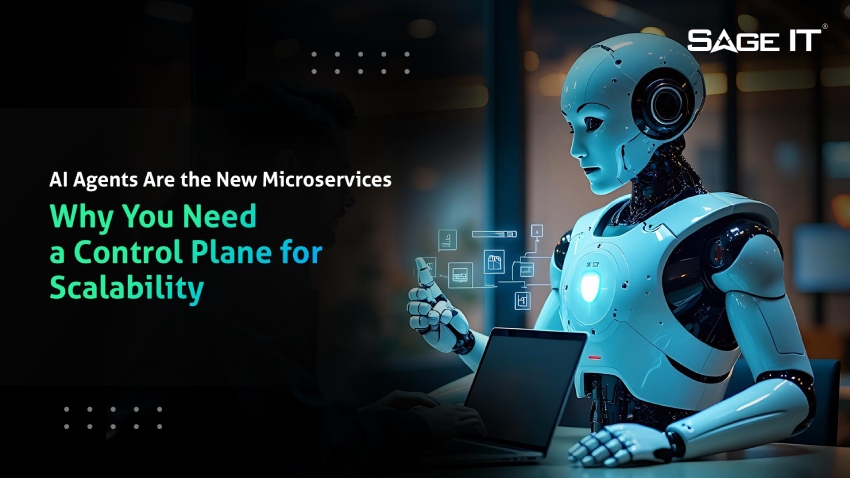
In the same way that microservices transformed system architecture by breaking down monolithic structures into smaller, manageable units, AI agents are now poised to take this further. If you have experience with microservices, you’ll recognize the familiar patterns: independent, deployable units that communicate and scale. However, AI agents bring an added layer of complexity.
Unlike microservices, which simply respond to predefined inputs, AI agents think, learn, and act autonomously. This means that scaling with AI requires a new kind of architecture, one that supports not just communication but intelligence and decision-making. In this article, we’ll explore why AI agents need a control plane to function effectively in your enterprise.
What Are AI Agents vs. Traditional Microservices?
| Aspect | Microservices | AI Agents |
| Definition | Microservices are independent, modular services that handle specific tasks and communicate via APIs. | AI agents are autonomous, decision-making entities that can adapt and act based on dynamic inputs. |
| Functionality | Each microservice executes a specific function, and they are isolated from each other. | AI agents not only execute tasks but also reason, learn, and adjust behavior over time to achieve goals. |
| Task Execution | Microservices are great for simple task execution, like processing a request or managing data. | AI agents handle more complex, real-time decision-making tasks, often requiring interaction across multiple systems. |
| Use Cases | Often used in cloud architectures, managing independent services like payment processing, authentication, etc. | AI agents are suited for environments requiring adaptive behaviors, like customer service bots or predictive maintenance systems. |
| Real-World Example | For instance, microservices in a retail app might handle inventory management, user authentication, or payment processing. | AI agents in a healthcare system might analyze patient data, predict potential issues, and initiate follow-up actions autonomously. |
| Interaction | Microservices communicate in a static way, usually via pre-defined APIs or message queues. | AI agents communicate based on their learned capabilities, adapting in real-time as they interact with systems and environments. |
| Flexibility | Microservices are flexible, but still rely on pre-defined workflows and static logic. | AI agents exhibit flexibility by dynamically adjusting to changes in environment, input data, and goals. |
Why Hard-Coded HTTP Endpoints Break at Scale
When scaling any enterprise system, relying on hard-coded HTTP endpoints becomes a significant limitation. At first, hard-coding may seem like a simple solution for communication between microservices or AI agents. However, as systems grow, so do the dependencies and complexities. These static connections quickly become fragile, unable to adapt to new agents, endpoints, or even changes in the network.
From our experience, as systems expand, the need for more dynamic and flexible integration becomes clear. The rigid structure that hard-coded endpoints create starts to break down. This leads to slower response times, more frequent failures, and higher maintenance costs. A critical issue is that, as AI agents proliferate and take on more complex roles, their interactions must evolve in real-time, something static HTTP connections can’t manage efficiently.
Enterprises need a flexible, scalable communication model that avoids the pitfalls of hard-coded endpoints. This is why we emphasize the importance of a control plane that facilitates seamless communication, discovery, and interaction across AI agents. This ensures that scaling does not compromise performance or reliability.
Control Plane for AI Agents
As enterprises scale their AI agent architectures, it becomes clear that managing hundreds or even thousands of agents across different systems and environments requires more than just basic integration. This is where the concept of a control plane comes into play. Think of it as the backbone of your AI agent ecosystem, providing a centralized framework for managing agent discovery, communication, and governance.
A robust control plane helps overcome the limitations of traditional methods by enabling seamless orchestration across different AI agents and their interactions. It offers a unified way to manage configurations, monitor performance, and apply security policies, ensuring consistency even as the number of agents grows. Without this centralized structure, agents may struggle to communicate effectively, and important operational controls could fall through the cracks.
Just as microservices use a control plane to manage service interactions, AI agents need one to ensure smooth, scalable, and reliable operations across enterprise workflows. This is the first step toward creating a future-proof AI agent architecture that can grow with your needs. Platforms like Archestra, our agentic business automation solution, provide the ideal control plane for orchestrating complex AI agent workflows at scale while ensuring safety, governance, and observability.
Agent-to-Agent (A2A) Protocol: Registry → Discovery → Invocation → Audit
As AI agents become a more integral part of enterprise operations, managing their interactions requires more than just simple API calls. A robust Agent-to-Agent (A2A) protocol ensures that these agents can discover one another, communicate, and take action within the framework of your organization’s needs.
To break it down, an Agent Registry acts as the central catalog for all available agents and their capabilities. It helps agents discover which others are suitable for collaboration, whether they are needed to share data or take specific actions. This process is more dynamic than the static connections we see in traditional microservices, where an endpoint is predefined and rarely changes.
Once agents discover each other, the Invocation step takes place. This is where the interaction between agents happens, often through message queues or direct requests, enabling real-time data sharing and decision-making. It’s important that this communication is smooth and reliable to ensure there are no bottlenecks.
Audit and Governance are key. With hundreds of agents interacting, it’s essential to have proper logging, tracking, and security measures in place to ensure compliance and prevent errors. A control plane that enforces these protocols provides the transparency and accountability needed for large-scale operations.
In practical terms, we’ve seen this approach enable smoother, more efficient workflows in environments where multiple systems need to interact seamlessly, such as customer support and supply chain management. This unified communication model ensures that agents can perform without disruption or unnecessary delays.
Why A2A-Style Protocols Matter for Scalability
As your AI agent ecosystem expands, traditional point-to-point communication methods break down under the weight of complexity. Hard-coded HTTP endpoints and rigid integrations fail to scale because they can’t adapt to the ever-changing landscape of interactions. This is where A2A protocols, like the one we’ve outlined, come in.
They offer a flexible, standardized way for agents to communicate regardless of the environment. Whether agents are distributed across cloud providers or handling different types of data, these protocols ensure smooth communication, reduce latency, and maintain operational continuity. In large-scale enterprise environments, this ability to scale efficiently is crucial for success.
Roadmap for Engineering Teams
To successfully scale AI agents within your enterprise, follow these practical steps:
- 1
Adopt Standardized Protocols: Start by implementing an Agent-to-Agent (A2A) protocol for seamless discovery and communication across agents.
- 2
Implement a Centralized Control Plane: Develop a robust control plane to manage agent orchestration, security, and performance monitoring.
- 3
Ensure Flexibility for Growth: Design your system to be adaptable, with a focus on scalability and minimizing dependency on hard-coded endpoints.
- 4
Integrate with Existing Systems: Ensure that AI agents can interact smoothly with your current infrastructure, from legacy systems to cloud-based applications.
- 5
Focus on Governance: Set up auditing, security measures, and compliance standards to monitor AI agent activities in real-time.
By following this roadmap, you’ll build a future-proof AI agent ecosystem that can grow and evolve with your business needs.