

Generative AI adoption in enterprises has surged dramatically. Gartner forecasts that by 2027, more than 50% of generative AI models used by enterprises will be specific to their industry or business function, up from about 1% in 2023.
As this cutting-edge technology reshapes industries, enterprise leaders are racing to leverage its potential for:
- Unprecedented operational efficiency
- Breakthrough innovation
- Enhanced customer experience
From automating the creation of personalized marketing content and customer support interactions, to accelerating pharmaceutical discoveries, generative AI empowers businesses to:
- Create entirely new data
- Generate predictive simulations
- Design engaging conversational agents
- Produce strategic business insights
Unlike traditional AI, which analyzes historical data, generative AI actively produces original outputs, including:
- Realistic images
- Conversational interfaces
- Predictive models
- Actionable business insights
With such transformative capabilities, it’s no surprise that leading organizations in finance, healthcare, retail, and manufacturing are making generative AI a top priority.
But to unlock its full potential, enterprises need:
- A clear understanding of the technology
- Strategic alignment with business goals
- Practical implementation guidance tailored to enterprise environments
Up Next
Here’s everything enterprise decision-makers need to know about generative AI:
- How it works
- Why it matters
- And how to make it a core pillar of your modern business strategy
Generative AI vs. Traditional AI: Understanding the Difference for Enterprise Success
While artificial intelligence has been transforming businesses for decades, Generative AI marks a significant evolution.
Gartner reports that enterprise adoption of generative AI will grow rapidly, with 75% of businesses projected to use generative AI to create synthetic customer data by 2026, up from less than 5% in 2023.
This underscores the need to clearly differentiate it from traditional AI.
Traditional AI (Discriminative AI)
Traditional AI primarily analyzes historical data to:
- Make predictions
- Classify data
- Detect patterns
It excels in tasks such as:
- Fraud detection
- Customer segmentation
- Predictive analytics
Example:
A financial institution may use traditional AI to flag potentially fraudulent transactions by analyzing historical spending patterns.
Generative AI
In contrast, Generative AI creates new, original data by learning underlying patterns from existing datasets.
It goes beyond analyzing and classifying, and is capable of generating novel outputs such as:
- Text
- Images
- Audio
- Simulations
Enterprise applications include:
- Producing hyper-personalized marketing content
- Simulating business scenarios
- Discovering new pharmaceutical compounds
Practical Enterprise Example:
- Traditional AI: A retail chain might analyze past purchasing patterns to predict future sales and optimize inventory.
- Generative AI: That same retailer can now auto-generate personalized product descriptions, customized promotional visuals, and realistic virtual environments for product testing, all from a simple text-based input.
Generative AI vs. Traditional AI: Key Differences
| Aspect | Traditional AI (Discriminative) | Generative AI |
|---|---|---|
| Primary Purpose | Analyze, classify, predict existing data. | Generate original, new content and data. |
| Learning Approach | Supervised learning (labeled data). | Unsupervised or semi-supervised learning (unlabeled data). |
| Enterprise Use Cases | Fraud detection, predictive maintenance, customer segmentation. | Content creation, virtual product simulations, personalized communications. |
| Output Examples | Classification labels, predictions, analytics insights. | Text content, images, audio, video, code, synthetic datasets. |
| Business Impact | Optimizes existing operations. | Innovates and expands capabilities, enabling new business models. |
Understanding these distinctions empowers enterprises to strategically invest in generative AI, unlocking unparalleled opportunities for innovation, efficiency, and market differentiation.
Historical Evolution and Milestones in Generative AI: From Theory to Enterprise Transformation
Understanding the evolution of generative AI reveals why today’s enterprises find themselves at the threshold of transformative potential. Generative AI, now a cornerstone technology for forward-thinking businesses, didn’t emerge overnight. Instead, it evolved systematically through breakthrough innovations, each expanding its capabilities, efficiency, and real-world applicability.
Here’s a concise yet comprehensive timeline of key milestones in generative AI:
Timeline of Generative AI Evolution:
| Year | Milestone | Significance to Enterprises |
|---|---|---|
| 2013 | Variational Autoencoders (VAEs) introduced by Kingma & Welling | VAEs enabled efficient data compression and reconstruction, allowing businesses to generate realistic, yet varied synthetic datasets, particularly for image and speech tasks. |
| 2014 | Generative Adversarial Networks (GANs) developed by Ian Goodfellow | GANs empowered enterprises to create highly realistic synthetic images and media, enhancing applications like visual design automation, deepfake detection, and multimedia content creation. |
| 2017 | Transformers & “Attention is All You Need” by Vaswani et al. (Google) | Transformers revolutionized natural language processing, enabling rapid, contextually-aware content generation. Businesses started leveraging these models for customer interactions, automated document generation, and advanced conversational agents. |
| 2020 | GPT-3 released by OpenAI | GPT-3’s massive scale and linguistic fluency opened new enterprise capabilities such as automated report writing, personalized content at scale, and improved customer experience through chatbots. |
| 2021-2022 | DALL-E & Stable Diffusion models emerged | Enterprises could now instantly produce photorealistic images and visual designs from text prompts, significantly streamlining creative workflows and enhancing marketing capabilities. |
| 2023-Present | GPT-4 and Multimodal AI advancements | GPT-4 and similar multimodal AI systems offer sophisticated understanding across text, images, and more, enabling entirely new use cases like integrated content creation, intelligent automation, and comprehensive digital assistants that closely mimic human interaction. |
These milestones aren’t merely technological advancements. They represent pivotal opportunities for enterprises to transform business processes, innovate rapidly, and gain substantial competitive advantages. Understanding this progression positions enterprises to better anticipate, and strategically harness, future developments in generative AI technology.
Key Generative AI Technologies: A Deep Dive
Understanding the underlying models powering generative AI is critical for enterprise decision-makers seeking to assess capabilities, risks, and opportunities. Below, we break down the leading technologies: what they are, how they work, where they’re most impactful, and how to think about them through relatable analogies.
Generative Pre-trained Transformers (GPTs)
How They Work: GPTs use transformer architectures with self-attention and positional encoding to generate coherent, contextually accurate text. These models predict the next word in a sequence based on previous inputs, allowing them to generate anything from short answers to detailed strategy documents.
Enterprise Use Cases:
- Automated report generation
- Customer support knowledge bases
- Executive briefings and personalized content at scale
Expert Insight: Survey data shows generative AI is already in regular use across enterprises, with the highest reported adoption in functions like marketing and sales and software engineering, which is exactly where GPT-style assistants create measurable speed and scale.
Analogy: Think of GPTs like elite executive assistants. They listen closely to context, understand your tone, and draft entire documents that feel human-made.
Diffusion Models
How They Work: These models start with random noise and learn to remove it step by step, reconstructing data in reverse until they form hyper-realistic images or video frames.
Enterprise Use Cases:
- Product visualization and marketing creatives
- Training simulations in manufacturing or defense
- Medical imaging enhancement
Expert Insight: Gartner projects worldwide end-user spending on generative AI models at $14.2B, with specialized models at $1.1B, reflecting rising enterprise demand for higher-fidelity, domain-tuned outputs that include advanced image generation
Analogy: Imagine a sculptor starting with a rough block of marble (random noise) and gradually chiseling away to reveal a detailed statue (image). That is how diffusion models refine data.
Generative Adversarial Networks (GANs)
How They Work: GANs pit two neural networks against each other. One is a generator that creates outputs, and the other is a discriminator that critiques them. This constant competition produces highly realistic outputs over time.
Enterprise Use Cases:
- Synthetic data generation for model training
- Realistic product mockups
- Fashion, gaming, and media innovation
Expert Insight: Gartner forecasts that by 2026, 75% of businesses will use generative AI to create synthetic customer data, showing synthetic data has moved from niche to mainstream enterprise practice.
Analogy: Picture a student writing a forged signature, and a teacher trying to spot the fake. Over time, the student gets better, until their signature becomes indistinguishable from the original.
Variational Autoencoders (VAEs)
How They Work: VAEs compress input data into a simplified “latent space” and then reconstruct it. They learn the essence of data patterns, enabling efficient data regeneration and variation.
Enterprise Use Cases:
- Generating variant designs or concepts
- Anonymizing sensitive datasets
- Accelerating early-stage R&D
Expert Insight: Deloitte’s enterprise research shows 34% of organizations are using AI to deeply transform core processes or business models, and another 30% are redesigning key processes around AI, which is where lightweight generative approaches support faster prototyping and iteration.
Analogy: Think of a VAE like a skilled summarizer, someone who reads an entire report, distills its essence into key ideas, and then recreates the full version from those ideas.
Autoregressive Models
How They Work: These models generate output one step at a time, using each new token to inform the next. They are deterministic and ideal for sequential content generation.
Enterprise Use Cases:
- Voice assistants and IVR systems
- Real-time transcription and translation
- Speech synthesis and voice cloning
Expert Insight: Gartner predicts that by 2026, more than 80% of enterprises will have used GenAI APIs or deployed GenAI-enabled applications in production, which is driving real-time, sequential generation needs in areas like service, speech, and code.
Analogy: Imagine writing a sentence one word at a time, where each new word depends on the previous one. It’s like a jazz soloist improvising note by note, always in sync with the melody.
By deeply understanding these core generative AI technologies, enterprises can strategically leverage their unique strengths to significantly improve operational efficiencies, drive innovation, and create competitive differentiation in today’s rapidly evolving business landscape.
Evaluating Generative AI Models for Enterprise Adoption: Key Metrics for Strategic Decisions
While generative AI promises revolutionary business transformations, selecting the right generative model demands careful evaluation. Enterprises must consider clear, strategic metrics to ensure alignment with business objectives, scalability, and ethical standards.
Here are five essential criteria for enterprise decision-makers evaluating generative AI technologies:
1. Quality: Ensuring Accuracy and Realism
Quality in generative AI directly impacts customer experience, trust, and adoption rates. High-quality outputs must:
- Demonstrate accuracy by reflecting underlying data reliably and consistently.
- Achieve realism, making synthetic content indistinguishable from real-world counterparts.
Enterprise Considerations:
- Marketing: Photorealistic visuals that resonate with customers.
- Customer Support: Chatbots providing accurate, human-like responses, increasing customer satisfaction.
Expert Insight:
Gartner predicts that by 2028, 50% of organizations will adopt a zero-trust posture for data governance as unverified AI-generated data grows, reinforcing that accuracy and provenance are now core quality requirements for enterprise GenAI.
2. Diversity: Mitigating Bias and Ensuring Inclusive Representation
Generative AI models must reflect inclusivity and fairness to meet ethical standards and customer expectations:
- Bias mitigation: Proactively identify and reduce biases inherent in datasets.
- Inclusive representation: Ensure generated outputs reflect diverse populations, scenarios, and use-cases.
Enterprise Considerations:
- Financial Services: Inclusive and unbiased lending decision models.
- HR & Recruitment: Generating job descriptions and candidate evaluations without implicit biases.
Expert Insight:
“Gartner found organizations that deployed AI governance platforms were 3.4 times more likely to achieve high effectiveness in AI governance, which is the foundation for bias controls, documentation, and repeatable fairness checks at scale.
3. Speed: Meeting Real-time Enterprise Needs
In many enterprise contexts, generative AI must operate rapidly, delivering immediate outputs to ensure smooth workflows and interactions:
- Real-time responsiveness: Essential for customer-facing scenarios like chatbots, virtual assistants, and interactive visualizations.
- Efficient inference times: Particularly crucial for high-volume content generation and automated processes.
Enterprise Considerations:
- Retail & E-commerce: Instantaneous personalized product recommendations.
- Customer Service: Real-time conversational agents swiftly resolving queries.
Expert Insight:
“With 71% of respondents reporting their organizations regularly use generative AI, performance and response time become production requirements, not nice-to-haves, especially for customer support and employee copilots.
4. Scalability & Cost: Sustainable Growth and ROI
Enterprise-wide deployment of generative AI demands robust scalability and cost-effectiveness:
- Computational resources: Consider GPU or cloud computing requirements and related operational costs.
- Return on Investment (ROI): Assess potential efficiencies, productivity improvements, and new revenue opportunities.
Enterprise Considerations:
- Manufacturing: Cost-effective design prototyping and simulation.
- Healthcare: Accelerating drug discovery without prohibitive infrastructure costs.
Expert Insight:
“Gartner projects worldwide end-user spending on generative AI models at $14.2B and estimates 148.3% year-over-year growth, which is why enterprises are now forced to treat scalability and unit economics as first-class selection criteria.
5. Ethics & Compliance: Robust Frameworks and Guidelines
Enterprises adopting generative AI must adhere to stringent ethical guidelines and compliance standards to safeguard against reputational, regulatory, and operational risks:
- Compliance adherence: GDPR, HIPAA, and industry-specific regulatory frameworks.
- Transparency & explainability: Clearly understanding and documenting how AI models produce outcomes.
Enterprise Considerations:
- Pharmaceuticals: Compliant AI-driven clinical trials and patient data handling.
- Financial Institutions: Transparent AI models for loan approvals and risk assessment.
Expert Insight:
“Deloitte’s enterprise research finds that managing risks and regulatory compliance are the top two concerns for global respondents when scaling generative AI strategies, making ethics and compliance operational requirements.
By systematically evaluating strategic criteria such as Quality, Diversity, Speed, Scalability and Cost, and Ethics and Compliance, enterprise leaders can confidently select and deploy generative AI solutions, ensuring tangible business outcomes and a sustainable competitive advantage.
Strategic Enterprise Use Cases & Real-World Success Stories
Generative AI is no longer a speculative tool. It’s driving tangible ROI across sectors. Below, we outline key enterprise applications by industry, accompanied by real-world success stories that illustrate measurable business value.
Finance
Use Cases:
- Intelligent fraud detection through synthetic transaction simulations
- Automated regulatory reporting and risk analysis
- Personalized financial product recommendations at scale
Success Story:
A global bank integrated GPT-based document automation into its compliance workflows, cutting turnaround time on regulatory documentation by 55% and saving over $4.8 million annually in manual processing costs.
Healthcare & Life Sciences
Use Cases:
- Accelerated drug discovery via AI-generated protein simulations
- Synthetic healthcare data generation for rare disease modeling
- Diagnostic image augmentation and summarization
Success Story:
A biotech firm using generative AI to model novel compounds saw a 12-month acceleration in its drug discovery pipeline, reducing go-to-clinical-trial timelines by 30% and potentially saving $10M+ in R&D expenditure.
Retail & E-Commerce
Use Cases:
- Personalized product descriptions at scale
- AI-powered demand forecasting and pricing optimization
- Automated campaign content for omnichannel marketing
Success Story:
A multinational retailer deployed generative content generation for product listings across 15 markets, resulting in a 75% reduction in content production time and a 22% uplift in product page conversion rates.
Manufacturing & Automotive
Use Cases:
- Design prototyping using 3D image generation
- Real-time supply chain scenario simulation
- Edge-case data generation for autonomous vehicle testing
Success Story:
A European auto manufacturer implemented generative design workflows for vehicle parts, enabling 40% faster prototyping cycles and reducing physical testing costs by $6.2M annually.
Telecommunications
Use Cases:
- Generative voicebots for Tier-1 customer support
- Network optimization through scenario generation
- Personalized upselling via AI-generated scripts
Success Story:
A leading telecom provider saw a 38% reduction in call center volume after deploying generative AI voice agents that resolved over 60% of Tier-1 issues autonomously. Media & Entertainment
Use Cases:
- Scriptwriting and storyboard generation
- Realistic animation frame filling
- Personalized gaming environments and assets
Success Story:
A game studio used generative 3D asset creation tools to cut environment design time by 50%, accelerating release schedules and improving artist output by 3x without increasing headcount.
Insight: Success is Not Just Automation, It’s Transformation
In every case, the common thread isn’t just cost-cutting. It’s strategic reinvention.
- Faster market entry
- Higher-quality outputs
- Better customer experiences
- New business models enabled by AI
Enterprise leaders who treat generative AI as an enabler of value, not just efficiency, are the ones redefining what’s possible.
Generative AI is already delivering tangible, quantifiable returns across diverse industries. By strategically leveraging these technologies, enterprises can accelerate innovation, optimize operational efficiency, and significantly enhance customer experiences. This sets new benchmarks for industry leadership and competitiveness.
Risks, Limitations, and Ethical Considerations: Ensuring Responsible Enterprise Adoption
Generative AI’s extraordinary capabilities are matched by equally significant responsibilities. Enterprise leaders must proactively address risks, limitations, and ethical implications to ensure sustainable and trustworthy deployment. Below, we highlight key considerations and provide clear, actionable strategies tailored for enterprises.
1. Data Security & Privacy: Compliance at the Core
Generative AI models often require vast amounts of data, posing significant data security and privacy challenges. Enterprises must adhere strictly to global regulatory standards, including GDPR and HIPAA.
Enterprise Best Practices:
- Data anonymization and masking: Remove personally identifiable information (PII) and confidential business data prior to training models.
- Robust access control: Implement role-based access control (RBAC) and stringent permissions frameworks.
- Continuous monitoring and audits: Regularly audit data usage, ensuring compliance and quickly addressing vulnerabilities.
Expert Insight:
“IBM reports that 13% of organizations experienced breaches of AI models or applications, and among those, 97% reported lacking proper AI access controls, underscoring that privacy and security controls must be built in before scaling.
2. Bias and Fairness: Building Inclusive AI
Generative AI models trained on biased datasets can unintentionally perpetuate societal biases, leading to unfair outcomes. It’s crucial to identify, mitigate, and continuously monitor model bias.
Enterprise Best Practices:
- Diverse, representative datasets: Ensure training data reflects a balanced representation across demographics.
- Bias audits and transparency: Regularly conduct fairness audits and transparently document findings.
- Human-in-the-loop oversight: Maintain expert oversight to actively correct biases identified during model deployment.
Expert Insight:
“Gartner found organizations that deployed AI governance platforms were 3.4 times more likely to achieve high effectiveness in AI governance, enabling repeatable bias evaluation, documentation, and oversight across use cases.
3. Accuracy and Hallucinations: Validating Model Outputs
Generative AI models occasionally produce inaccurate or misleading content, commonly called hallucinations. This poses serious risks in critical applications like healthcare and finance.
Enterprise Best Practices:
- Rigorous validation processes: Implement automated and human-led validation to verify accuracy.
- Model fine-tuning: Continuously train models on specialized, enterprise-specific datasets to minimize inaccuracies.
- Transparency measures: Clearly communicate when content is AI-generated, enabling end-users to critically evaluate outputs.
Expert Insight:
“Gartner predicts that by 2028, 50% of organizations will implement zero-trust data governance as unverified AI-generated data grows, signaling that hallucination risk is being addressed through stronger provenance, validation, and trust controls.
4. Environmental Sustainability: Balancing Innovation and Energy Consumption
Generative AI models require considerable computational resources, contributing to increased carbon footprints. Environmental sustainability must remain central to deployment strategies.
Enterprise Best Practices:
- Energy-efficient infrastructure: Invest in energy-efficient GPUs, cloud computing solutions, and data centers powered by renewable energy sources.
- Optimized algorithms: Leverage parameter-efficient training methods (e.g., LoRA, distilled models) to reduce computational load.
- Carbon offset initiatives: Adopt measurable carbon offset strategies for AI workloads.
Expert Insight:
“Gartner projects generative AI model spending at $14.2B with rapid growth, which is why enterprises are increasingly prioritizing efficiency tactics like smaller specialized models, optimization, and workload governance to control compute and energy demand.
5. Recommended Governance Frameworks and Ethical Guidelines
For effective, responsible deployment of generative AI, enterprises must implement comprehensive governance frameworks aligning ethical considerations with business objectives.
Enterprise Best Practices:
- Clear ethical guidelines: Establish detailed internal guidelines around data handling, transparency, bias, fairness, and accountability.
- AI governance committees: Form cross-functional governance teams ensuring adherence to standards, regulatory compliance, and alignment with enterprise ethics.
- Continuous training and awareness: Provide employees ongoing education around AI ethics, risks, and responsibilities.
Recommended Ethical Framework:
| Principle | Explanation | Enterprise Application |
|---|---|---|
| Transparency | Clearly disclose AI use and limitations. | Openly labeling AI-generated content and decisions. |
| Accountability | Define clear responsibility for AI outcomes. | Document ownership for model accuracy, bias mitigation, and compliance monitoring. |
| Fairness & Inclusivity | Ensure AI solutions do not perpetuate bias. | Implement regular bias assessments and corrective actions. |
| Data Privacy & Security | Uphold stringent privacy standards. | Enforce data anonymization, encryption, and strict access control. |
| Sustainability | Minimize environmental impacts. | Invest in efficient infrastructures and carbon offset programs. |
Expert Insight:
“Gartner survey data shows organizations that deployed AI governance platforms were 3.4 times more likely to achieve high effectiveness in AI governance, which directly supports trust, oversight, and scalable adoption across the enterprise.
By thoughtfully addressing these critical considerations, such as Data Security, Bias Mitigation, Accuracy Validation, Environmental Sustainability, and Ethical Governance, enterprise leaders can responsibly deploy generative AI technologies. This holistic approach ensures that innovation aligns with business values, meets regulatory requirements, and builds stakeholder trust. In doing so, it safeguards long-term success.
Actionable Steps for Enterprise Generative AI Adoption: A Proven Framework for Scalable Deployment
Successful generative AI adoption in the enterprise isn’t about chasing hype. It’s about strategic execution. Whether you’re launching a pilot or scaling a company-wide deployment, these steps provide a clear and practical roadmap to help your organization adopt generative AI with confidence, compliance, and a competitive advantage.
1. Conduct an Internal AI Readiness Audit
Before deploying any generative AI solutions, enterprises must evaluate their existing digital maturity, data infrastructure, and AI governance models.
Key audit dimensions:
- Data availability & quality: Are your datasets diverse, labeled, secure, and compliant?
- Workflow automation maturity: Are manual processes already digitized or AI-augmentable?
- IT architecture alignment: Can your infrastructure support large-scale inference and API-based integrations?
- Security & compliance posture: Do you have role-based access, encryption, and compliance protocols in place?
Outcome: Identify the most viable, high-impact areas to implement generative AI first, such as content generation, customer support, or report automation.
2. Train Employees in AI Fluency & Prompt Engineering
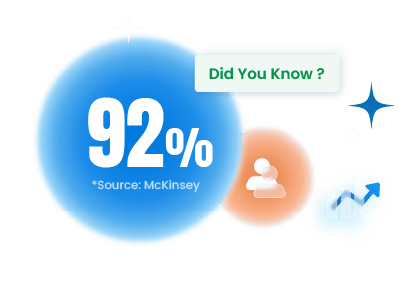
Generative AI thrives when business teams understand how to interact with it. Yet, according to McKinsey, over 60% of enterprise teams lack functional AI literacy. This is a major barrier to effective adoption.
Recommended training tracks:
- Prompt engineering fundamentals: Teach business users how to frame instructions to generate accurate, useful outputs.
- Function-specific AI literacy: Tailor training for marketing, legal, HR, and product teams on using AI tools aligned to their workflows.
- Change management and governance workshops: Align cross-functional stakeholders on ethical use, escalation processes, and oversight best practices.
Outcome: Build internal AI champions and reduce reliance on external consultants, accelerating adoption.
3. Establish a Cross-Departmental AI Steering Committee
Siloed experimentation results in fragmented value. Centralized governance ensures strategic alignment, ethical oversight, and scalable innovation.
Committee responsibilities:
- Define and monitor KPIs for AI performance and ROI.
- Approve toolsets and vendors across departments to ensure cohesion.
- Enforce compliance, risk management, and security standards.
- Evaluate ethical considerations, such as use of personal data and IP risk.
Composition:
- IT leaders, legal/compliance officers, security professionals, HR representatives, and functional business owners.
Outcome: Enterprise-wide clarity, reduced deployment friction, and standardized governance across departments.
4. Evaluate Build vs. Buy: Custom Models vs. SaaS Platforms
Enterprises must decide whether to develop proprietary models or use existing platforms, depending on use-case complexity, data sensitivity, cost, and speed to value.
Build (Custom Models)
- Pros: Tailored to your data, full control, domain-specific performance.
- Cons: High infrastructure cost, longer development time, requires MLOps maturity.
Buy (Enterprise SaaS AI Platforms like OpenAI, AWS Bedrock, Microsoft Copilot, Salesforce Einstein GPT)
- Pros: Fast implementation, low overhead, built-in governance tools.
- Cons: Limited customization, risk of vendor lock-in, API pricing scales with use.
Hybrid Approach:
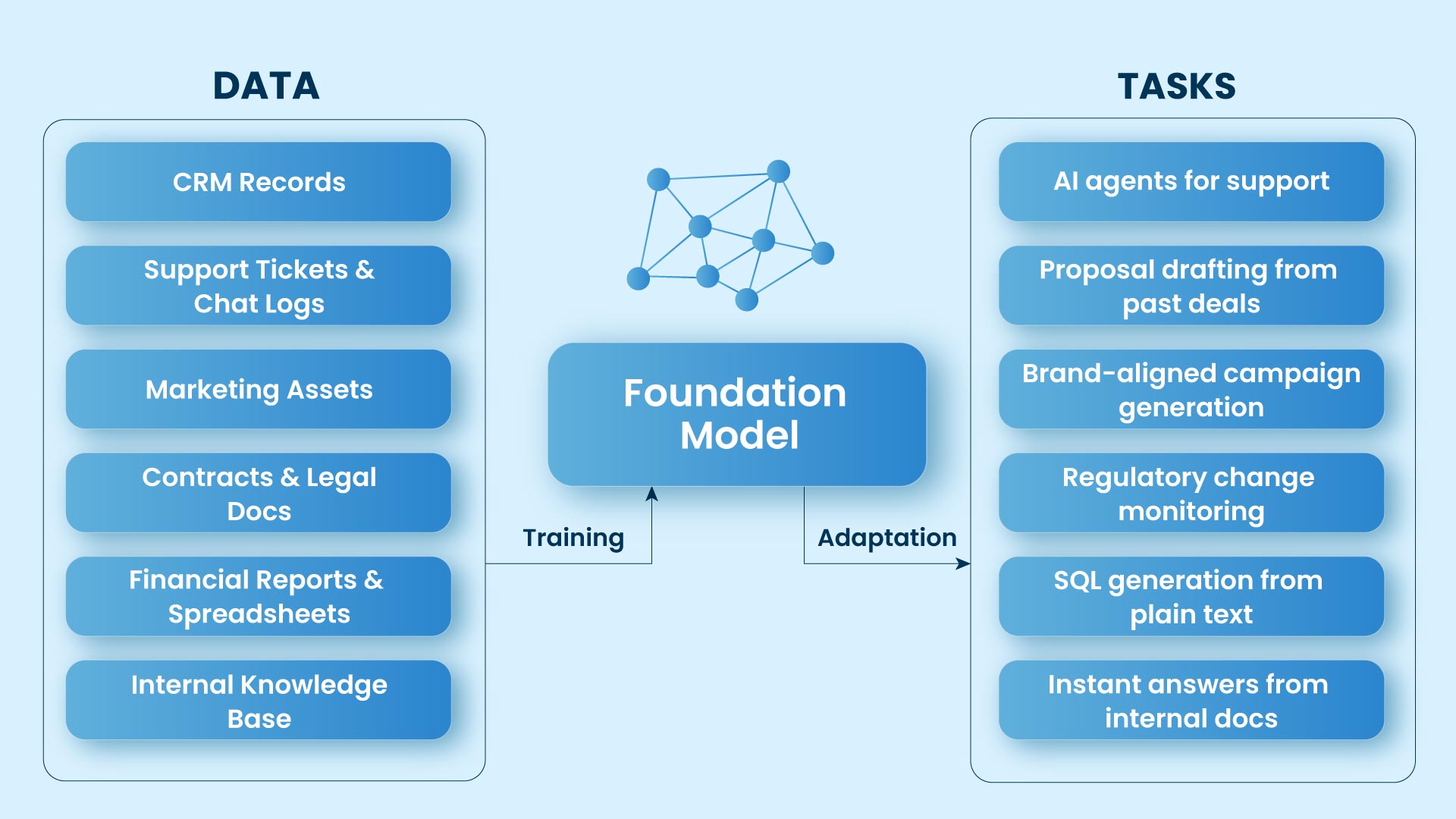
- Use pre-trained foundation models with retrieval-augmented generation (RAG) or fine-tuning on proprietary data to balance control and scalability.
Outcome: Choose the right strategic investment path aligned to technical capabilities, data sovereignty needs, and ROI expectations.
Bonus: Create a Use Case Prioritization Matrix
Evaluate and rank potential generative AI applications using these dimensions:
- Business impact (revenue, cost savings, efficiency)
- Technical feasibility (data availability, model readiness)
- Compliance risk (regulatory exposure, ethical concerns)
- Time-to-value (development and deployment complexity)
Outcome: A focused, de-risked deployment roadmap that balances experimentation with measurable business outcomes.
By following this framework—Readiness Audit, AI Training, Governance Setup, and Strategic Build/Buy Decisioning—enterprises can move from pilots to production with confidence, compliance, and scale. For hands-on expertise to accelerate that journey, explore our generative ai consulting, which helps align use cases to ROI, implement governance, and operationalize AI safely across functions. This structured approach ensures not just adoption but long-term competitive advantage.
Generative AI Tools and Platforms: Enterprise Perspective
Choosing the right generative AI platform isn’t just a tech decision. It’s a strategic move with long-term implications for scalability, security, compliance, and innovation. For enterprise leaders, the ideal platform must strike the right balance between performance, flexibility, and governance.
Below is an expert-driven review of today’s top enterprise-ready generative AI platforms, evaluated through a practical enterprise lens.
Microsoft Azure OpenAI Service (Copilot)
Overview:
Microsoft’s deep integration with OpenAI’s GPT-4 via Azure has positioned Copilot as a powerhouse for enterprise productivity. It’s embedded across the Microsoft 365 suite, Dynamics, Power Platform, and custom Azure environments.
Enterprise Strengths:
- Seamless integration with existing Microsoft ecosystem (Outlook, Word, Excel, Teams, etc.)
- Robust compliance with over 90+ certifications (including FedRAMP, GDPR, HIPAA)
- Customization via Azure Machine Learning and prompt flow orchestration
Use Case Examples:
- Automated sales proposal generation in Dynamics
- Legal document drafting in Word
- AI-assisted analytics in Excel
Ideal For:
Enterprises already within the Microsoft ecosystem looking for a secure, productivity-driven AI companion.
AWS Bedrock and Amazon Q
Overview:
AWS Bedrock offers a multi-model access layer to leading foundation models (Anthropic Claude, Meta LLaMA, Cohere, and more) without the need to manage infrastructure. Amazon Q, on the other hand, brings enterprise-grade AI assistance for developers and business users.
Enterprise Strengths:
- Zero infrastructure management, with API access to best-in-class models.
- Granular security controls (VPC, encryption, IAM integration)
- Scalable customization using fine-tuning and Retrieval-Augmented Generation (RAG)
Use Case Examples:
- Generating synthetic financial datasets
- Internal knowledge assistants with RAG
- AI-enhanced customer support via Amazon Connect
Ideal For:
Cloud-native enterprises that prioritize model diversity, deep AWS stack integration, and robust compliance tooling.
Google Vertex AI and Gemini
Overview:
Google’s Vertex AI platform offers end-to-end ML lifecycle management, with access to Gemini, Google DeepMind’s multimodal foundation model.
Enterprise Strengths:
- Industry-leading model performance in multimodal tasks (text, image, code)
- Integrated MLOps capabilities for managing, deploying, and monitoring models at scale
- Advanced data governance tools (Data Loss Prevention API, AI Explanations, Vertex AI Search)
Use Case Examples:
- Real-time personalization in ecommerce
- AI-assisted creative workflows with Gemini for image & video
- Search-augmented document understanding for legal and healthcare
Ideal For:
Innovation-driven enterprises seeking advanced AI capabilities and seamless GCP integration.
Salesforce Einstein GPT and Agentforce
Overview:
Salesforce is embedding generative AI deeply into its CRM backbone through Einstein GPT and Agentforce, creating AI-native workflows across Sales, Service, Marketing, and Commerce.
Enterprise Strengths:
- Unified customer data access via Salesforce Data Cloud
- Auto-generated sales emails, summaries, and chat replies directly within workflows
- Built-in trust layer for privacy-aware AI outputs
Use Case Examples:
- Real-time service ticket resolution
- Auto-personalized B2B sales outreach
- AI-generated marketing journeys in Marketing Cloud
Ideal For:
Customer-centric enterprises seeking to infuse AI into CRM-driven interactions.
Open-Source Options: Stable Diffusion, Meta’s LLaMA
Overview:
For enterprises that require full control, cost efficiency, or operate in highly regulated environments, open-source generative AI provides flexibility and extensibility.
Key Platforms:
- Stable Diffusion (image generation): Ideal for creative workflows, brand visual generation, training on proprietary visual datasets.
- Meta LLaMA 3 (language model): A strong alternative to GPT with full deployment control and open weights.
Enterprise Strengths:
- No vendor lock-in
- On-premise or private cloud deployment options
- Highly customizable through fine-tuning
Caveats:
- Requires in-house MLOps maturity
- Needs robust internal governance to ensure responsible use
Ideal For:
Enterprises prioritizing data sovereignty, IP control, and domain-specific fine-tuning.
Choosing the Right Platform: Enterprise Considerations
| Selection Criteria | What to Evaluate | Why It Matters |
|---|---|---|
| Compliance & Governance | Does the platform support GDPR, HIPAA, SOC 2, etc.? | Protects from legal risk and ensures enterprise-grade trust. |
| Customization Capability | Can you fine-tune or use your proprietary data securely? | Determines relevance and precision for industry-specific use cases. |
| Security Architecture | Is data encrypted at rest/transit? RBAC in place? | Prevents data leakage and enforces strict access control. |
| Model Performance | Are latency, accuracy, and multimodal support strong? | Impacts UX and operational efficiency. |
| Ecosystem Integration | Does it embed into existing workflows and tools? | Reduces friction and accelerates ROI. |
| Cost & Licensing | API pricing, training costs, open-source advantages | Ensures budget alignment and scalability. |
The best generative AI platform for your enterprise is the one that:
- Aligns with your existing infrastructure
- Meets compliance and governance needs
- Scales with your growth
- Delivers measurable business value
Whether you choose a robust SaaS solution, cloud-native framework, or an open-source stack, ensure your selection is driven by enterprise context, not hype.
Note: These are among the leading enterprise platforms today. However, model capabilities, benchmarks, and governance requirements are changing quickly, so enterprises should reassess platform fit quarterly to stay aligned with evolving features, digital trust controls, and compliance expectations.
Future Trends & Innovations: What’s Next for Enterprise Generative AI
As generative AI matures beyond experimentation, the enterprise focus is shifting from adoption to optimization and innovation. The next frontier lies in building intelligent ecosystems where generative models operate in tandem with other AI disciplines, integrated securely across functions, and aligned with strategic outcomes.
Here are the most powerful trends shaping the next wave of enterprise transformation, and how forward-looking leaders can prepare.
Hybrid Intelligence: Merging Generative and Predictive AI
What’s Changing:
Generative AI is no longer siloed. It’s being fused with predictive analytics, recommendation engines, and causal inference to create hybrid intelligence systems.
Enterprise Impact:
- Combine customer journey prediction with content generation for personalized experiences in real-time.
- Forecast demand using predictive models, then generate automated supply chain responses.
- Pair anomaly detection with autonomous report generation in finance and compliance.
“By combining predictive analytics and generative AI capabilities, enterprises can simulate outcomes, improve decision precision, and move faster from insight to action.”- Forrester
Real-time Generative Decision-Making
What’s Changing:
Enterprises are shifting from batch-based generation to low-latency, real-time systems embedded into high-stakes workflows like customer service, fraud mitigation, and logistics.
Enterprise Impact:
- Live co-pilots for sales reps, generating answers and proposals mid-call.
- Automated fraud case escalation based on real-time evidence synthesis.
- Instant executive dashboards populated via generative summarization from live data.
Gartner says more than 80% of enterprises will have used generative AI APIs or deployed generative AI-enabled applications in production environments by 2026, which is why real-time decision-making is moving from “nice to have” into a core investment driver for enterprise AI.
Agentic AI: Autonomous Enterprise Agents
Agentic AI solutions enable enterprises to deploy autonomous agents that manage multi-step workflows and execution across business processes
Gartner predicts that 40% of enterprise applications will feature task-specific AI agents by 2026, which signals a shift from narrow assistance to foundational infrastructure where agents orchestrate multi-step workflows inside core business systems.
Meanwhile,
Gartner predicts that 40% of enterprise applications will feature task-specific AI agents by 2026, up from less than 5% in 2025, which is why CIOs are prioritizing agentic AI in operational domains where latency and execution matter, such as supply chain exception handling, customer support triage, and sales workflow acceleration.
This isn’t science fiction. Forrester’s 2026 outlook notes that enterprise software is shifting from enabling humans to accommodating a digital workforce of AI agents, forcing leaders to decide how far to digitize processes and orchestrate workflows independent of human workers. That shift turns agentic AI into both a competitive advantage and an operational imperative.
Composable AI Ecosystems: Modular, Scalable Innovation
What’s Changing:
Monolithic AI deployments are giving way to Composable AI, a modular architecture in which enterprises can mix and match best-in-class models, APIs, and microservices for different tasks.
Enterprise Impact:
- Use OpenAI for marketing copy, Anthropic for compliance reasoning, and custom LLaMA for proprietary use cases, all within a single platform.
- Plug-and-play AI agents across CRM, ERP, HRIS, and security systems.
- Future-proof AI stack where components can be swapped or upgraded independently.
“Vendor fragmentation will cause a majority of enterprises to build composable agent architectures. These ‘agentlakes’ will manage and orchestrate fractured AI agent deployments and enable complex multiagent use cases”
Bonus: Emerging Enterprise Trends to Watch
| Trend | Strategic Implication |
|---|---|
| Multimodal AI | Combines vision, text, audio for richer, cross-channel enterprise insights |
| Edge Generative AI | Real-time, privacy-compliant generation on-device (e.g., in retail, IoT) |
| Synthetic Enterprise Data | Generate safe, diverse data for AI training without real-world risk |
| AI Agents with Memory | Agents that recall past interactions, improving personalization and intent prediction |
Ready for What’s Next?
To stay ahead, enterprise leaders must:
- Adopt modular architectures that allow fast integration of emerging models.
- Build AI governance that evolves with innovation.
- Invest in AI-native talent fluent in prompt engineering, orchestration, and ethics.
- Embrace experimentation while aligning with clear, measurable KPIs.
The next wave of generative AI won’t just support your teams; it will empower them to do what was previously impossible.
The Enterprise Imperative: Moving Forward with Generative AI
Generative AI isn’t a fleeting trend. It is a transformative force redefining how enterprises innovate, operate, and compete. From real-time content creation and intelligent automation to accelerated R&D and personalized customer experiences, the value is not just emerging; it is compounding.
But unlocking its full potential requires more than interest. It demands strategic foresight, ethical governance, and enterprise-wide alignment.
What Comes Next?
As AI ecosystems evolve, we are entering an era of hybrid intelligence, autonomous agents, and composable AI platforms. Generative AI will no longer just augment workflows. Instead, it will orchestrate them, dynamically adapting to market changes, customer signals, and internal objectives in real time.
“Generative AI is not only shaping today’s enterprise landscape, but it is also architecting the foundation of tomorrow’s intelligent enterprise.”
The time for passive observation is over. Those who act boldly, investing in readiness, governance, and intelligent integration, won’t just keep pace with the future. They will define it.
FAQs on Generative AI in Business
Generative AI refers to algorithms that can create new content, such as text, images, or data, based on patterns learned from existing inputs. Unlike traditional AI, it doesn’t just analyze data; it creates original outputs.
Enterprises use generative AI for content generation, customer service automation, predictive simulations, design prototyping, and more.
Traditional AI predicts outcomes using historical data, while generative AI creates new content like images, text, and simulations.
Risks include data privacy breaches, biased outputs, model hallucinations, and high compute costs. Mitigating these requires strong governance.
ChatGPT is called generative AI because it creates original responses in natural language based on user input. It generates new text, rather than retrieving predefined answers, by predicting the next word using patterns learned from massive datasets.
Generative AI is a broad category of AI that creates new content, such as text, images, or audio, based on training data. ChatGPT is a specific generative AI model developed by OpenAI. It focuses on generating human-like text for conversations, writing, and more.
No, Alexa is primarily a rule-based voice assistant that uses traditional AI for tasks like command recognition and information retrieval. While Alexa includes some generative capabilities, it is not fully generative AI like ChatGPT, which creates new, dynamic content.